- PRODUCT DESSCRIPTION:
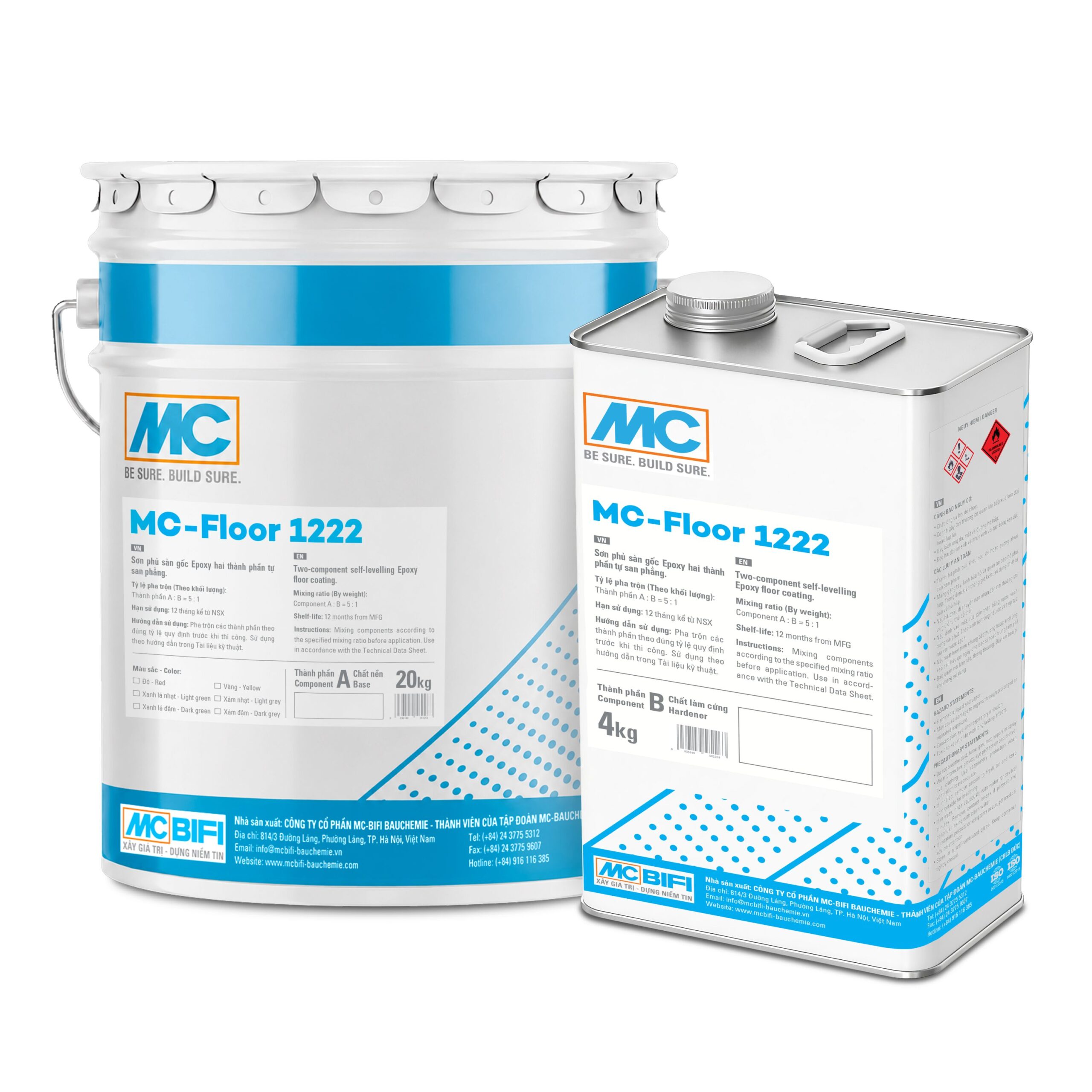
➢ MC-Floor 1222 is a two-component Epoxy floor coating system, pre-measured for easily direct mixing and application on-site.
➢ After curing, it creates a smooth, bright and slightly reflective surface, available in a variety of colors.
- PRODUCT PROPERTIES:
➢ Fast application.
➢ Chemically resistant – good resistance to a wide range of chemicals.
➢ Durable – good abrasion resistance.
➢ Hygienic – provides a dense, impervious, seamless.
➢ Floor surface which is easily cleaned.
➢ Solvent free – non tainting.
➢ High aesthetic appeal – diverse colors, enhancing the working environment.
- AREAS OF APPLICATION:
➢ MC-Floor 1222 is designed for use in a wide range of light industrial environments where a lasting solution to floor maintenance problems is required.
➢ It provides a dense, impervious, coloured and chemically resistant floor surface which is hygienic, easy to clean.
➢ Typical applications include clean rooms, laboratories, plant rooms, light industrial plants, pharmaceutical and electronic industries.
- CHEMICAL PROPERTIES:
MC-Floor 1222 has excellent resistance at ambient temperatures to a wide range of industrial chemicals. Specific data is available on request.
- PRODUCT CHARACTERISTICS:
| Estimating supply | MC-Floor 1222: 24kg/ set.
Priming and cleaning products: MC-EP Primer: 17.5 kg/set; MC-Thinner EP: 5 liters/can. |
| Shelf-life & Storage | All products have a shelf life of 12 months if stored in a dry place in their original, unopened packaging.
Store in a dry place at a temperature of 5°C – 30°C, away from heat sources and open flames, in unopened packaging. Storage at higher temperatures may reduce the shelf life. |
| Precautions Health and safety | Avoid contact with skin, eyes, or ingestion.
Work in a well-ventilated area and avoid inhaling solvent vapors. Wear full protective gear, including gloves and safety glasses. If working in enclosed spaces, respiratory protection equipment is required. Use a protective skin cream. If skin contact occurs: wash with plenty of clean water and soap. If eye contact occurs: rinse immediately with clean water and seek medical attention. If swallowed: do not induce vomiting; seek medical attention immediately. |
| Fire | MC-EP Primer and MC-Thinner EP are flammable materials. Keep away from sources of ignition. No smoking. In the event of fire extinguish with CO2 or foam. Do not use a water jet. |
| Disposal | Spillages of component products should be absorbed onto earth, sand or other inert material and transferred to a suitable vessel. Empty packaging should be in accordance with local waste disposal regulations. |
| Additional information | A technical note relating to the survey and preparation guidelines for resin floor installation is available. Please request from the local MC office.
MC manufactures a wide range of products specifically designed for the specialist flooring industry. These include liquid-applied, chemically-resistant coatings, self-levelling epoxy toppings and trowel-applied, highly abrasion resistant screeds. |
- INSTRUCTION OF USE:
➢ MC-Floor 1222 should be applied by specialist applicators who must follow the procedures laid down in the product method statement. MC works with a network of such applicators that have been trained in the correct installation procedures. The construction process includes the following steps:
➢ Surface preparation: It is essential that MC-Floor 1222 is applied to clean, sound and dry surfaces in order that maximum bond strength is achieved between the substrate and the flooring system. All dust and debris should be removed prior to application of the product and its primer. Concrete or cement-based substrates must be at least 28 days old, with a moisture content not exceeding 5%. Laitance deposits on new concrete are best removed by light grit blasting, mechanical scabbling or grinding.
➢ Mixing:
– MC-Floor 1222 consists of two pre-measured components (base and hardener), ready for immediate application on-site. Do not subdivide the components for mixing, as this will affect the performance and aesthetics of the floor.
– Mixing should be carried out using either forced action mixer or heavy duty, slow-speed drill with proprietary mixing paddle attachment. The components should be mixed in suitably sized vessel.
– Mix the base mixture (Component A) for 30-45 seconds, until homogeneous. Then add the hardener (Component B) and mix for another 3 minutes, until a uniform color and texture are achieved.
➢ Application:
– Ensure sufficient equipment, personnel, and materials are available to allow for continuous construction work on a given floor area.
– The material should be poured onto the prepared and primed substrate as soon as mixing is complete. It should be spread to the required thickness preferably using a pin screed, if not a serrated trowel; with care taken not to overwork the resin, spreading evenly and slowly.
– Immediately after laying, the material should be rolled, using a spiked nylon roller, to remove slight trowel marks, and to assist air release. The rolling should be carried out using a ‘back and forth’ technique along the same path. An overlap of 50% with adjacent paths is recommended.
– The rolling process should continue for a minimum of 5 times on the same path, but should be prior to setting of the product.