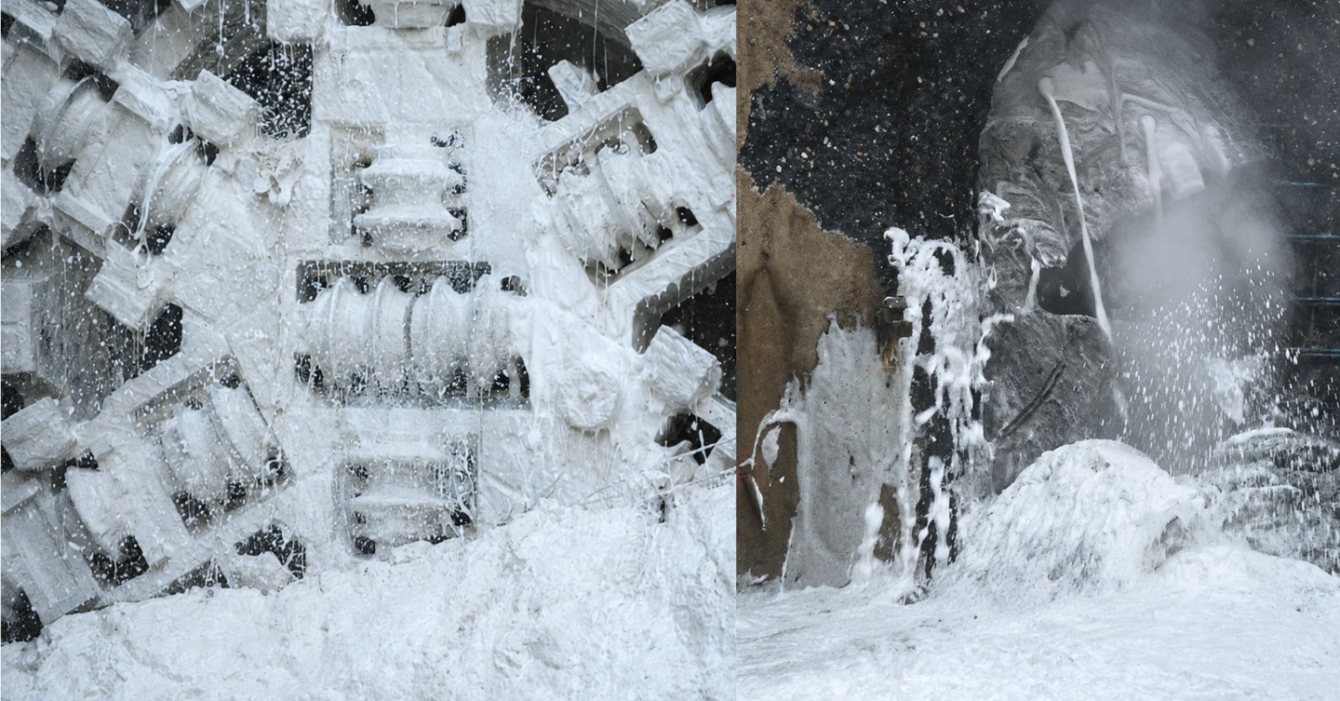
From highly adhesive clay and loose sandy soils to complex mixed ground conditions, each geological formation presents distinct challenges for Tunnel Boring Machine (TBM) operations. Controlling the properties of excavated soil is therefore essential to maintaining operational efficiency and stability throughout the tunnelling process.
Particularly in Earth Pressure Balance Tunnel Boring Machines (EPB TBMs), soil conditioning plays a crucial role in improving the properties of excavated material, supporting excavation chamber pressure control, optimising material transport and maintaining suitable operating conditions.
How does TBM soil conditioning work? Which types of conditioning agents are commonly used, and what solutions are suitable for different geological conditions? This article explores the key principles, technologies and applications of soil conditioning in EPB TBM tunnelling.
1. What Is TBM Soil Conditioning?
TBM soil conditioning is the process of using conditioning agents, such as foaming agents, polymers, water or specialised additives, to modify the physical and mechanical properties of excavated soil to meet the technical requirements of tunnel construction using TBMs.
In EPB TBM tunnelling, excavated soil is not merely material that must be removed from the excavation chamber. It also forms an integral part of the mechanism used to balance pressure at the tunnel face. Therefore, the excavated material must exhibit suitable plasticity, deformability, workability, permeability and pressure transmission characteristics.
By selecting and applying appropriate soil conditioning additives, the properties of excavated material can be improved to support TBM operations under different geological conditions.
Soil conditioning is particularly important for EPB TBMs, where excavated soil is directly used to generate the pressure required to support the tunnel face.
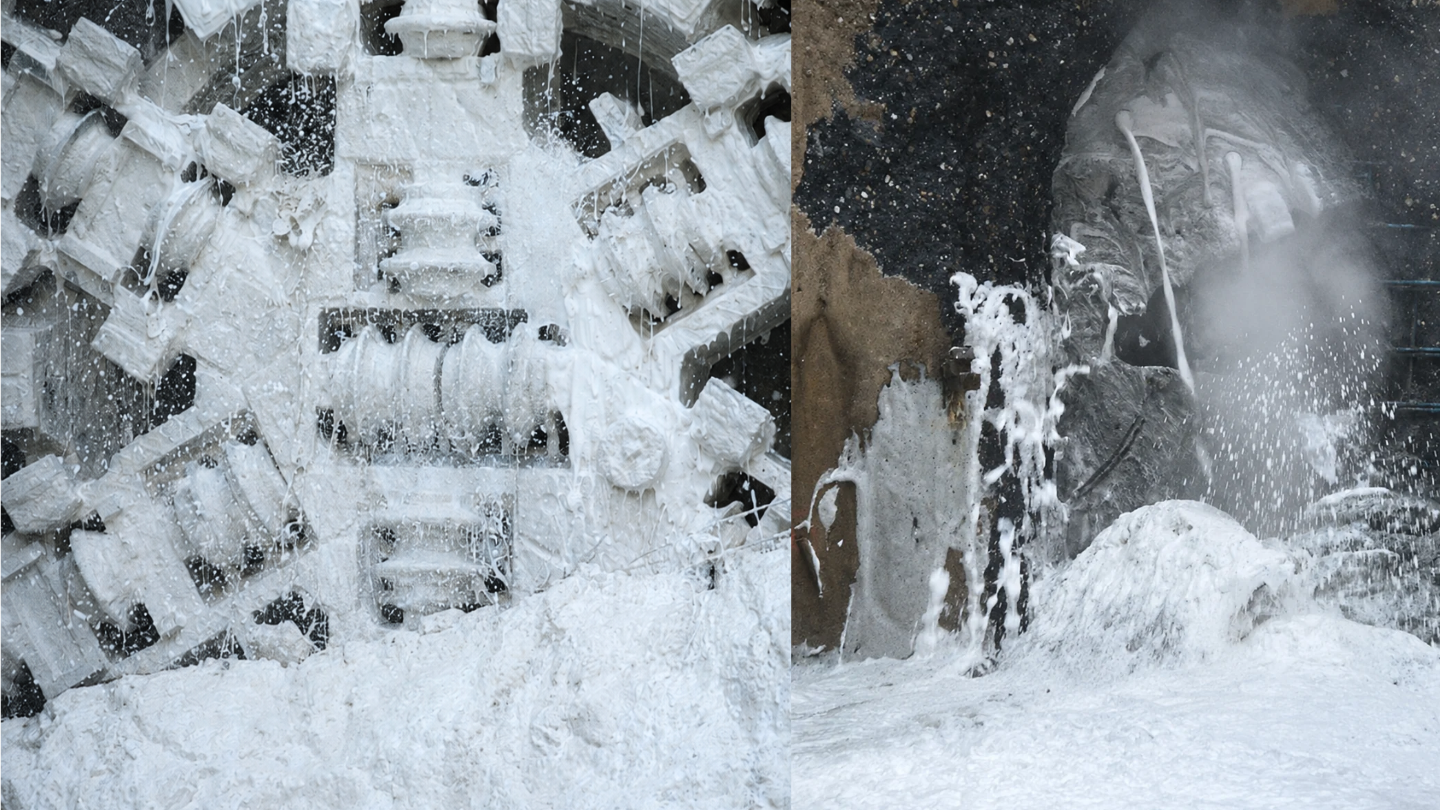
2. Why Is Soil Conditioning Important in EPB TBM Tunnelling?
The operational performance of an EPB TBM depends significantly on the condition of the material within the excavation chamber. If the soil is excessively dry, loose, sticky or has unsuitable permeability, maintaining pressure control and transporting excavated material can become challenging.
This is why soil conditioning is an essential technical solution in EPB TBM tunnelling, helping improve the condition of excavated soil, maintain stable operating conditions and deliver practical benefits throughout tunnel construction.
2.1. Supporting Tunnel Face Pressure Control
In EPB TBM tunnelling, as the cutterhead excavates the ground at the tunnel face, the excavated material enters and is retained within the pressurised excavation chamber behind the cutterhead.
This material is maintained at an appropriate consistency and pressure to provide face support, balancing the earth and groundwater pressures acting on the tunnel face. This helps reduce the risk of ground instability during excavation.
TBM soil conditioning solutions improve the homogeneity, workability and deformability of excavated material, supporting pressure transmission and pressure maintenance within the excavation chamber. As a result, they contribute to tunnel face stability and suitable operating conditions.
2.2. Improving Soil Workability and Excavated Material Transport
Properly conditioned soil can achieve the plasticity and flow characteristics required for efficient movement within the excavation chamber and transportation through the screw conveyor.
This is particularly important in geological formations where the natural soil properties are unfavourable for excavation and spoil removal using EPB TBMs.
2.3. Reducing Soil Adhesion and Clogging
In highly cohesive clay formations, excavated material can readily adhere to and accumulate on cutting tools, the cutterhead and components of the material transport system. This phenomenon can increase resistance, obstruct the movement of excavated material and potentially cause clogging or interruptions to TBM operations, affecting excavation efficiency and construction progress.
The application of suitable soil conditioning additives helps modify the surface characteristics and consistency of excavated soil, reducing adhesion and clogging risks while supporting stable TBM operation.
2.4. Supporting Optimised TBM Operational Performance
Soil conditioning plays an important role in improving soil workability and maintaining suitable material consistency within the pressurised excavation chamber. When excavated soil exhibits properties compatible with the machine’s operating requirements, TBM performance can be supported through improved material transport, better control of excavation chamber conditions and reduced ground-related operational difficulties.
To achieve effective soil conditioning, the selection of conditioning solutions should consider geological characteristics, additive properties, application parameters and the actual operating conditions of each project
3. Working Principles of Soil Conditioning in EPB TBM Tunnelling
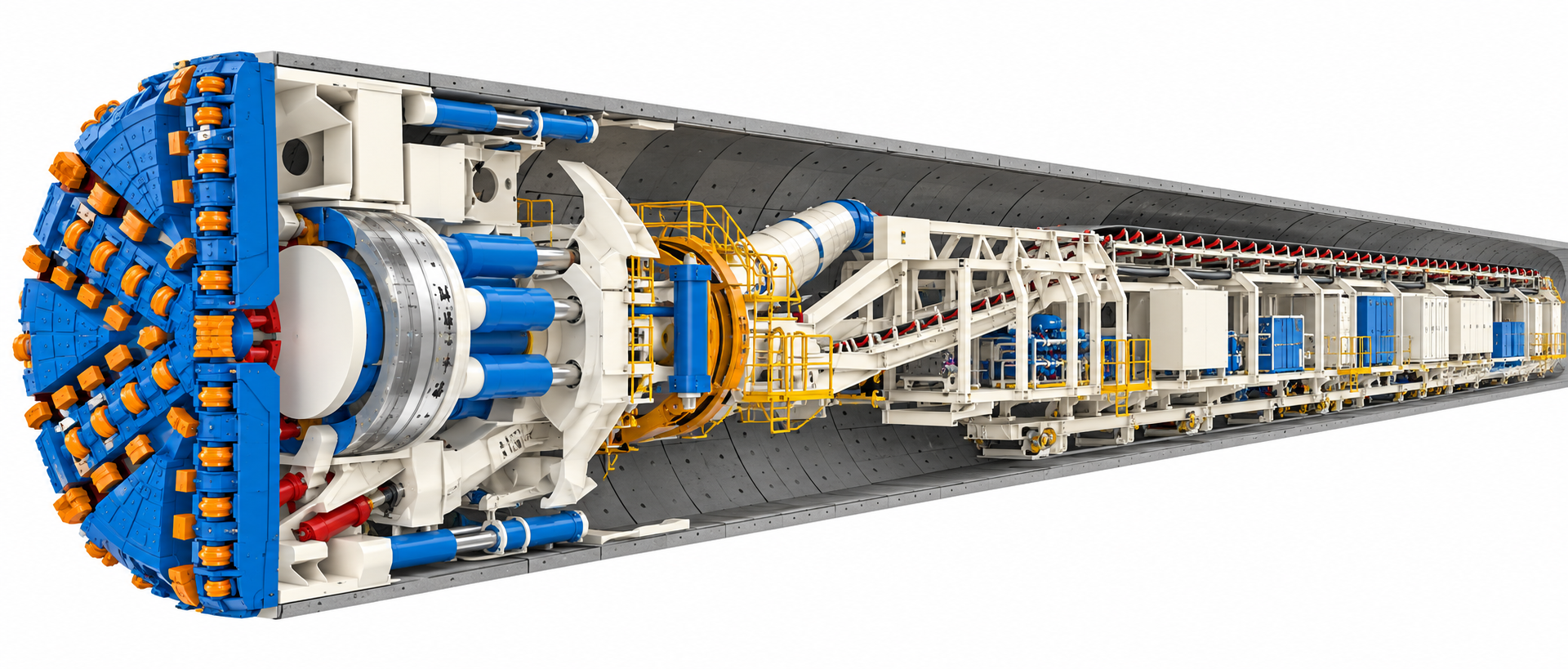
Soil conditioning in EPB TBMs involves introducing conditioning agents into excavated material at designated locations within the machine.
Depending on the TBM design, foaming agents, polymers or other additive solutions may be injected through the cutterhead, into the excavation chamber or at other locations within the spoil transport system.
3.1. Preparation of Soil Conditioning Solutions
Foaming agents are typically diluted with water to a specified concentration. The resulting solution is then mixed with air in a foam generation system to produce foam with properties suitable for the intended application.
For polymers and other additives, preparation methods depend on the product characteristics and the design of the dosing and injection system.
3.2. Injection of Conditioning Agents into Excavated Soil
Foam or conditioning solutions are injected into the soil during excavation and mixed with the excavated material at designated injection points. This process aims to modify the condition of the excavated soil and facilitate the formation of a mixture with workability characteristics suitable for EPB tunnelling requirements.
3.3. Monitoring and Adjustment During TBM Operation
Parameters such as additive dosage, solution concentration, Foam Expansion Ratio (FER) and Foam Injection Ratio (FIR) must be evaluated according to geological conditions and the actual response of the excavated material.
Effective soil conditioning involves not only selecting the appropriate additives but also monitoring and adjusting application parameters throughout the different stages of tunnel construction.
4. Common Types of TBM Soil Conditioning Solutions
Depending on geological characteristics and operational requirements, soil conditioning solutions may be applied individually or through combinations of different additives.
4.1. TBM Soil Conditioning Foaming Agents
Foaming agents are among the most commonly used soil conditioning additives in EPB TBM tunnelling.
When converted into foam and introduced into excavated soil, these agents can help improve the workability, deformability and consistency of the material within the excavation chamber.
Selecting a suitable foaming agent requires consideration of geological characteristics, foam generation performance, foam stability and TBM operating parameters.
4.2. TBM Soil Conditioning Polymers
Polymers are used to modify certain properties of excavated soil, including water retention, cohesion, viscosity and mixture stability, depending on the polymer type and application conditions.
Under certain geological conditions, polymers may be combined with foaming agents to improve the consistency of excavated material and meet specific operational requirements.
4.3. Anti-Clay Adhesion Additives
In highly adhesive clay formations, soil accumulation on the cutterhead and other TBM components can negatively affect operational efficiency.
Anti-adhesion additives are developed to help reduce adhesive interactions between clay and equipment surfaces, contributing to improved transport of excavated material.
4.4. Soil Conditioning Solutions for TBM Start-Up
The TBM start-up phase may require specific supporting conditions to establish suitable material consistency within the excavation chamber and spoil transport system.
Specialised start-up solutions are selected according to the machine design, geological conditions and project-specific start-up procedures.
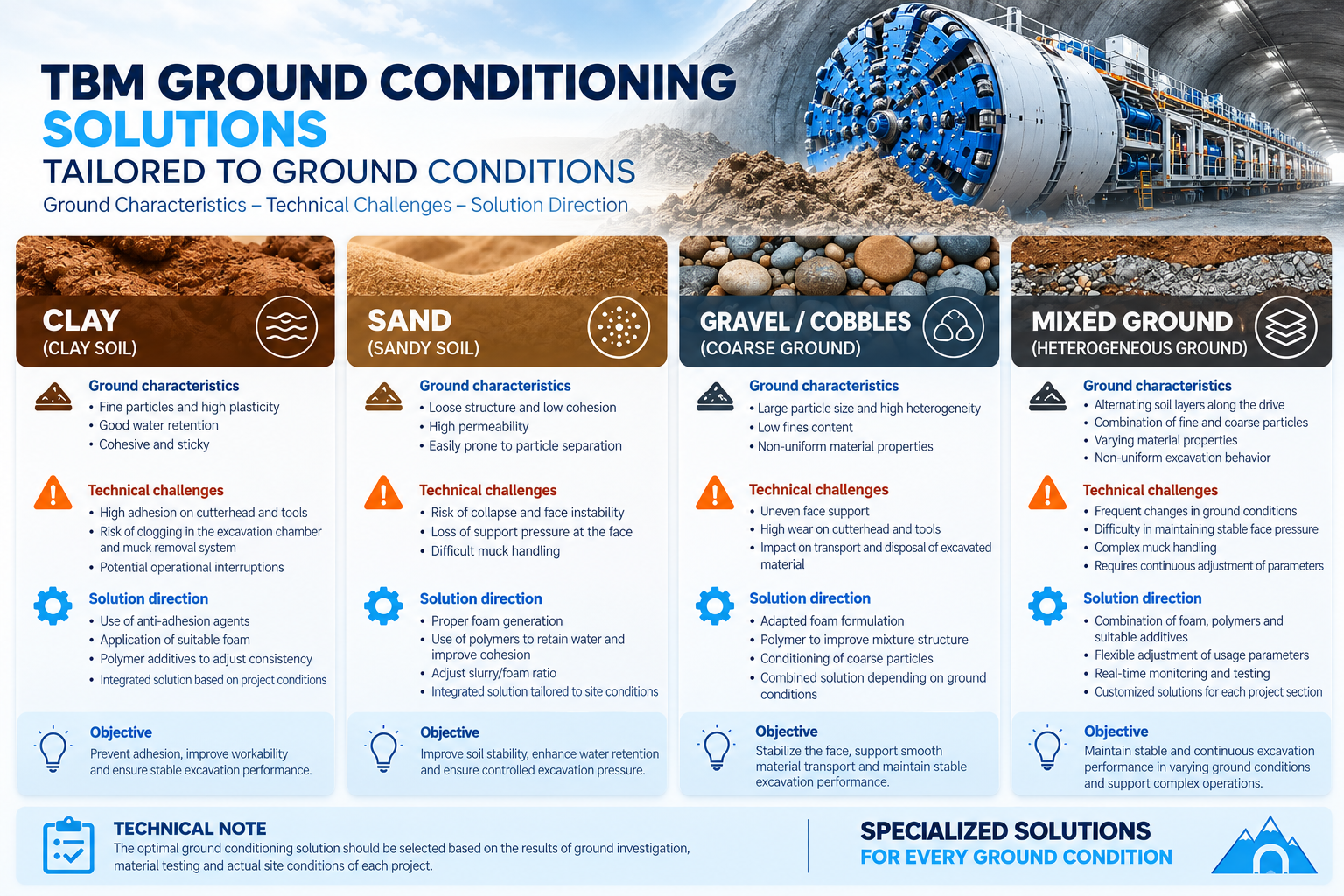
5. Selecting TBM Soil Conditioning Solutions for Different Geological Conditions
The diversity and complexity of geological formations create different requirements for TBM soil conditioning.
Therefore, selecting an appropriate solution requires careful consideration of excavated material characteristics and actual TBM operating conditions.
5.1. Highly Adhesive Clay Formations
Clay soils can cause adhesion and clogging at the cutterhead, excavation chamber and screw conveyor, particularly when moisture content and plasticity increase the tendency of soil to adhere to equipment surfaces.
Under these conditions, soil conditioning should focus on controlling material consistency and reducing adhesion through the selection of suitable additives and application parameters.
5.2. Sandy and Loose Soil Formations
Sandy soils may exhibit low cohesion and relatively high permeability, making it difficult to achieve material consistency and workability suitable for the excavation chamber.
Foaming agents or polymers may be considered to improve soil consistency, homogeneity and water control characteristics.
5.3. Gravel, Cobbles and Coarse-Grained Formations
Geological formations containing a high proportion of coarse particles often present challenges related to loose material behaviour, particle segregation and excavated soil workability.
Soil conditioning solutions should be selected based on particle size distribution, fines content, groundwater conditions and the ability to develop a soil mixture compatible with the EPB operating mechanism.
5.4. Mixed Ground and Variable Geological Conditions
In tunnel alignments passing through multiple geological layers, the characteristics of excavated material can vary significantly between sections.
Such conditions require flexible soil conditioning strategies that allow adjustments to additive types, concentrations and injection ratios according to actual ground conditions.
6. Key Technical Parameters in TBM Soil Conditioning
In addition to selecting appropriate additives, effective soil conditioning depends on establishing and controlling key technical parameters.
FER – Foam Expansion Ratio: The ratio of generated foam volume to the volume of the foaming solution used.
FIR – Foam Injection Ratio: The ratio of injected foam volume to excavated soil volume, according to the calculation method adopted for the project.
Cf – Foam Concentration: The concentration of foaming agent in the prepared solution.
WIR – Water Injection Ratio: The ratio of added water to excavated soil quantity, based on the applicable calculation method.
Foam Stability: The ability of foam to maintain its characteristics under the relevant application conditions.
These parameters are interrelated and should be evaluated in combination with the characteristics of the excavated soil.
For example, increasing the amount of injected foam does not necessarily result in better soil conditioning performance. An appropriate injection ratio must satisfy the requirements for soil workability, material consistency and actual TBM operating conditions.
Therefore, laboratory testing and on-site evaluation are important steps in selecting and fine-tuning soil conditioning parameters.
7. Key Factors to Consider When Selecting TBM Soil Conditioning Additives
To select suitable soil conditioning solutions, contractors and technical teams should conduct a comprehensive assessment of several factors.
Geological Conditions: Particle size distribution, fines content, plasticity, moisture content, permeability and the characteristics of individual soil layers.
EPB TBM Operating Requirements: Excavation chamber pressure conditions, screw conveyor material transport characteristics, additive injection system design and other relevant operating parameters.
Soil Conditioning Performance: The ability to improve workability, reduce adhesion, control water and maintain suitable excavated material consistency.
Solution Compatibility: The compatibility of foaming agents, polymers and specialised additives when used in combination under specific application conditions.
Environmental Considerations: Environmental properties of additives, relevant test data and project requirements for excavated material management.
In addition to technical performance, environmental characteristics such as ready biodegradability, assessed according to the internationally recognised OECD 301 F test method, and potential impacts on the aquatic environment, including Water Hazard Class 1 (WGK 1) classification, may also be considered for products with corresponding assessment documentation.
Related Article: TBM Soil Conditioning – Optimizing TBM Operations with Eco-Friendly Approach
8. MC Underground – Specialised Chemical Solutions and Technologies for TBM Soil Conditioning
As a specialised business unit of MC-Bauchemie Group (Germany), backed by more than 60 years of experience, a presence in over 50 countries and a global workforce of more than 3,500 employees, MC Underground (MCU) provides specialised chemical solutions and technologies for tunnelling and underground construction.
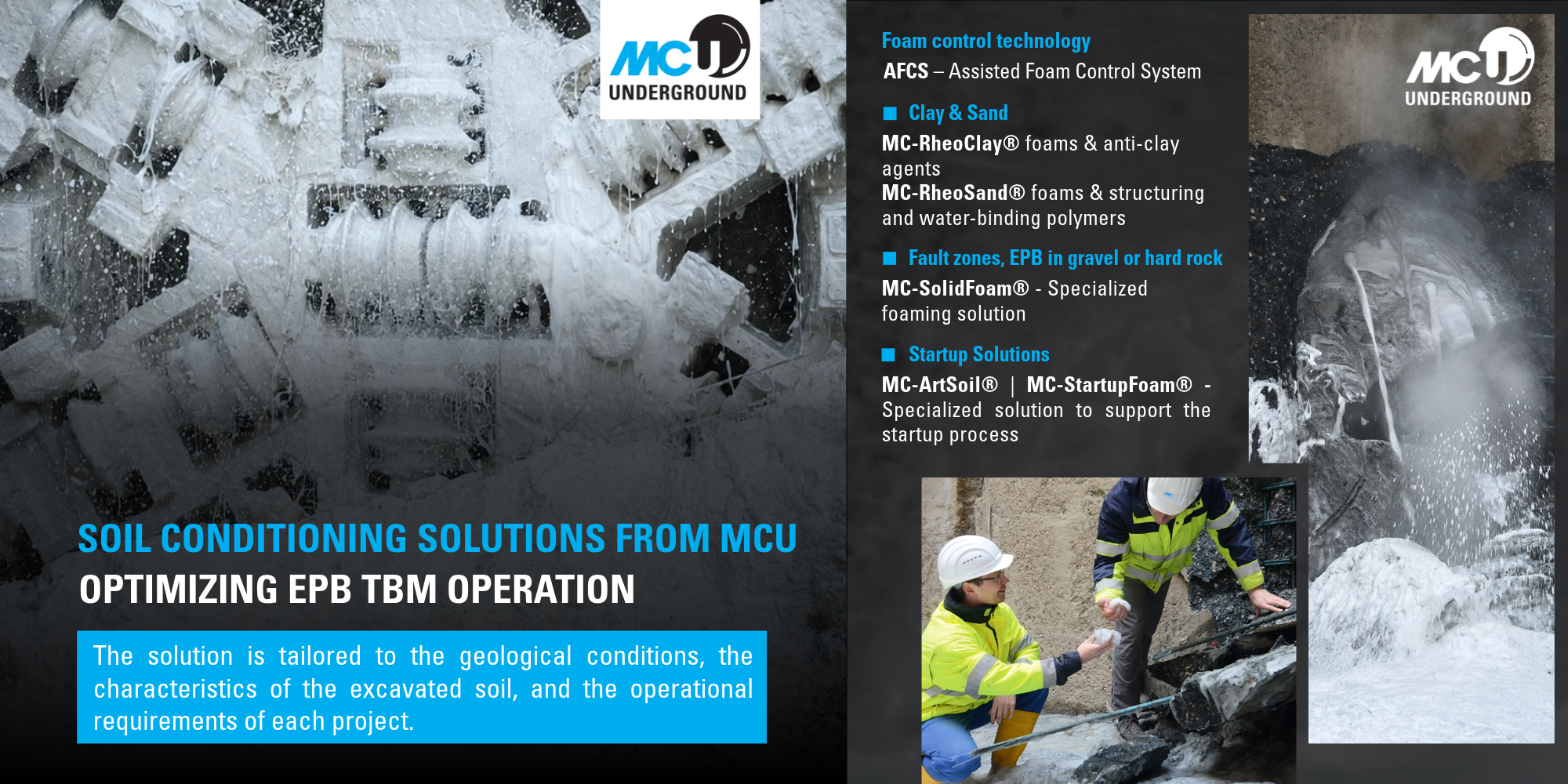
For EPB TBM applications, MCU has developed a portfolio of soil conditioning solutions designed to address different technical requirements and geological conditions, including:
MC-RheoClay®: Solutions for clay formations, supporting adhesion control and reducing water demand.
MC-RheoSand®: Polymer solutions that help improve the structure and water retention properties of excavated soil.
MC-SolidFoam®: Specialised foam conditioning solutions for specific geological conditions.
MC-ArtSoil® and MC-StartupFoam®: Solutions designed to support the TBM start-up phase.
AFCS: Automated Foam Control System technology supporting the management and control of foam generation.
MCU’s strength lies not only in its specialised product portfolio but also in the integration of chemical solutions, application technologies and technical expertise to address the diverse operational requirements of tunnelling projects.
Beyond soil conditioning, MCU also offers a comprehensive range of solutions for TBM tunnelling, including main bearing lubrication and sealing, tail shield sealing, annular gap backfill grouting and technical injection systems.
Explore MC Underground’s Comprehensive TBM Chemical Solutions and Technologies
TBM Soil Conditioning: Technology, Working Principles and Applications in Tunnel Construction