





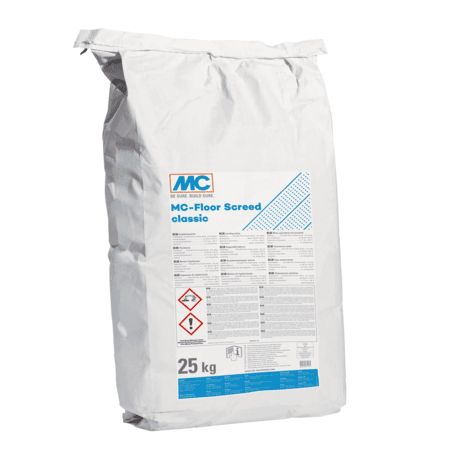
- PRODUCT PROPERTIES:
➢ Ready to use – simply mix with water.
➢ Low shrinkage.
➢ Can be applied in layer thickness between 10 mm and 60 mm per work step.
➢ Can be pumped with screed-pumps.
➢ Quickly loadable.
➢ Easy manual processing, can be worked with blade trowels.
➢ Frost-resistant when completely hardened.
➢ Frost-thaw resistant according to DIN CEN/TS 12390-9.
➢ Strength category EN 13813-CT-C40-F6-A15-B1.5.
- AREAS OF APPLICATION:
➢ Levelling of uneven cement screed- and concrete floors.
➢ Levelling and manufacture of screeds on steeply sloped areas, e.g. ramps.
➢ Manufacture of screeds on separating layers and compound screeds in indoor and outdoor areas.
- TECHNICAL DATA:
| Characteristic | Unit | Value* | Comments |
| Working time | minutes | approx. 30 | |
| Application conditions | °C | > 5 < 30 | |
| Consumption | kg/m²/mm | approx. 2 | |
| Density | g/cm³ | approx. 2.15 | |
| Water addition | l | 3 – 3.5 | per bag 25 kg |
| Flexural strength:
48 hours 7 days 28 days |
N/mm² |
approx. 4 approx. 4.9 approx. 6.8 |
|
| Compressive strength:
48 hours 7 days 28 days |
N/mm² |
approx. 25 approx. 35 45 |
low temperatures delay, higher temperatures accelerate the curing process |
| Accessible after | hours | approx. 24 | |
| Shrinkage | mm/m | < 0.6 | |
| Layer thickness | mm | ≥ 10 ≤ 60 | |
| Tensile strength | N/mm² | 1.5 | B 1.5 |
| Abrasion resistance per Böhme test | cm³/50 cm² | < 15 | A 15 |
| Resistant to de-icing salts | no |
*All technical values are laboratory results determined at 21°C ±2°C and 50% relative humidity.
- PRODUCT CHARACTERISTICS:
| Form | pulverous |
| Fire classification | ovg. fraction < 1% |
| Colour | grey |
| Resistance to thermal cycling | yes |
| Resistance to freeze/thaw cycling | yes |
| Delivery form | 25 kg sack (pallet: 40 x 25 kg) |
| Self-monitoring | EN ISO 9001 |
| Storage | Can be stored in cool and dry conditions for at least 12 months in original unopened packs. |
| Packaging disposal | Make sure single-use containers are completely empty. |
- APPLICATION NOTES:
➢ Floor heating must be turned off 24 hours before the application of MC-Floor Screed classic. Depending on the intended use and the area of application of MC-Floor Screed classic the relevant technical regula- tions, EN 13813 must be observed.
➢ Substrate preparation for compound screeds and repair work: For a composite application the use of the high-quality bonding agent MC-Estribond MB is necessary to improve the adhesion. On the substrate preparation please observe the information of the relevant technical data sheets for the bonding agent.
➢ Substrate preparation for screed on separating layer: No bonding agent is necessary for applications on a separating layer. The substrate must be smooth and load-bearing and allow for an even layer- thickness.
➢ Mixing:
– For mixing 3 – 3.5 litres of fresh water are filled into a clean container. Remember that, as with any cemetitious product, the water requirement may vary.
– MC-Floor Screed classic is added bit by bit under continuous stirring. Use slow moving agitators for mixing (max. 400 rpm). Agitators with two counter rotating paddles are optimal, e.g. beba mixer B7, Collomix RGE 162 Duo, etc. Forced mixers are also suitable.
– The mixing takes approx. 2-3 minutes. An “earth-moist” consistency is necessary for processing.
– Partially cured material must not be stirred and/or used again.
– The freshly applied and processed mortar, if it is already hardening, must not be re-touched or rubbed down.
➢ Application: MC-Floor Screed classic is worked into the fresh bonding layer in a single layer. MC-Floor Screed classic must only be processed at substrate and ambient temperatures of at least +5°C.
➢ Curing:
– During the curing period the freshly applied MC-Floor Screed classic must be protected from stress of any kind (e.g. draft, direct sunlight, extreme temperature fluctuations, moisture, premature traffic, etc.)! If the incompletely cured screed mortar is exposed to moisture, e.g. rain or dew, light discolorations may appear on the surface.
– For heating screeds start the heat-up process after the screed has hardened completely after 28 days. The flow temperature is raised by 5°C per day until the maximum has been reached. After three days on the maximum flow temperature, it is again reduced step by step.
