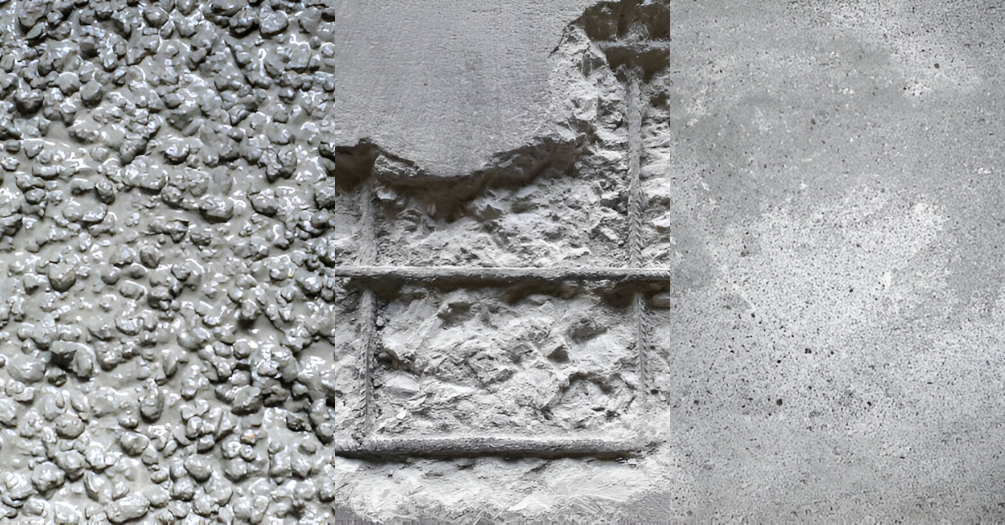
Concrete plays a fundamental role in every construction project, directly determining the quality and durability of the structure. To meet diverse construction conditions and usage requirements, various types of concrete with different properties and advantages have been developed. This article will help you understand each type of concrete and choose the most suitable option for your project.
What is concrete?
Concrete is a construction material made from a mixture of cement, fine and coarse aggregates (such as sand, gravel, or crushed stone), water, and concrete admixtures that improve its properties. When water mixes with cement, a chemical reaction known as hydration occurs, binding the aggregate particles together and transforming the initially plastic mixture into a solid mass. As a result, concrete achieves high compressive strength and excellent durability against environmental factors over time.
Classification of concrete
Every construction project has unique technical requirements that depend on the scale, design load, environmental conditions, and construction methods. Therefore, classifying concrete helps civil engineers and contractors easily choose the most suitable concrete type to meet the project’s specific demands. Below are the most common classification criteria used today:
Based on concrete grade
Concrete grade indicates its compressive strength after 28 days, measured in MPa or designated by the symbol “M” (e.g., M200 ≈ 20 MPa). The higher the grade, the greater the load-bearing capacity, making it suitable for heavily loaded structures such as foundations, columns, and beams. Meanwhile, medium or low grades are used for non-structural components such as partition walls or internal roads.
Based on bulk density
Based on its bulk density, concrete is classified into several categories:
- Extra heavy concrete (> 2500 kg/m³): Used in specialized structures requiring radiation shielding or very high load-bearing capacity.
- Normal-weight concrete (1800–2500 kg/m³): The most common type, used in primary load-bearing elements.
- Lightweight concrete (500–1800 kg/m³): Reduced weight, ideal for projects requiring lighter structures and good thermal insulation.
- Ultra-lightweight concrete (< 500 kg/m³): Used for insulation and soundproofing applications.
Based on type of binder
Different binding materials can be used to hold the aggregates together. The most common type is Portland cement concrete, which offers high strength and durability, suitable for most structural works. Another type is silicate concrete, made from lime combined with specific additives, often used in precast products such as bricks or wall panels. Gypsum concrete, on the other hand, is lightweight and provides good thermal resistance, suitable for non-load-bearing or fire-resistant elements.

Based on type of aggregate
Variations in aggregate types – such as crushed stone, gravel, or broken brick – create concrete with distinct properties. Dense aggregate concrete made with hard aggregates like crushed stone provides high strength. Lightweight aggregate concrete, made with materials such as expanded clay, fly ash, or blast-furnace slag, offers lower weight and good insulation. Special aggregate concrete, using materials like barite or magnetite, is designed for acid-resistant, radiation-shielding, or other specialized engineering applications.
Based on application
Each type of concrete is designed for specific functional purposes. Heat-resistant concrete is used in furnaces and thermal power plants. Structural concrete serves as the standard material for most load-bearing components. Hydraulic concrete is used in water-related structures such as dams and reservoirs, due to its high resistance to moisture and water pressure.
Common types of concrete in construction
From the classification criteria above, it’s clear that each type of concrete is designed to meet different technical requirements, construction conditions, and purposes. Let’s explore the most common types of concrete used in construction today, along with their advantages and practical applications, so you can choose the most suitable option for your project.
1. Normal concrete
Normal concrete is the simplest and most widely used type, made by mixing cement, sand, and crushed stone in traditional proportions.
- Advantages: Cost-effective, easy to produce and place, simple quality control, suitable for most basic structures.
- Applications: Foundations, slabs, columns, beams, and other standard load-bearing components.
2. High-performance concrete (HPC)
This type is specially designed to achieve superior performance compared to normal concrete. It may feature higher strength, improved workability, better impermeability and durability, or faster setting time — achieved through the use of optimized mix designs and concrete admixtures.
- Advantages: Enhances construction quality and service life, ensuring structural safety even under harsh environmental conditions.
- Applications: Large-scale infrastructure such as bridges, high-rise buildings, tunnels, and other structures requiring high strength and durability.
3. Ready-mix concrete
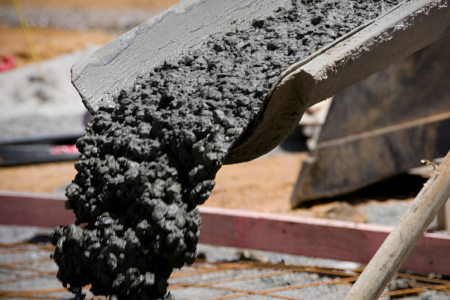
Also known as fresh concrete or ready-mixed concrete, it is produced at batching plants under strict quality control and then transported to the job site by mixer trucks. This ensures consistent mix proportions and uniform quality, minimizing errors compared to on-site mixing.
- Advantages: Guarantees consistent quality for every batch, saves time and labor.
- Applications: Medium to large-scale projects such as high-rise buildings, industrial zones, and bridge structures.
4. Reinforced concrete
Reinforced concrete combines the compressive strength of concrete with the tensile strength of steel reinforcement. Since concrete performs poorly in tension, steel bars are embedded to create a composite system with enhanced structural performance.
- Advantages: Excellent load-bearing capacity, increased durability, suitable for complex structural elements.
- Applications: Commonly used for beams, columns, slabs, and frames in high-rise buildings, bridges, factories, and other heavy-load structures.
5. Lightweight concrete
Produced by replacing normal aggregates with lightweight materials such as expanded clay (keramzit), pumice, or expanded polystyrene (EPS) beads.
- Advantages: Reduces structural dead load, provides excellent thermal and acoustic insulation, lowers transportation and installation costs.
- Applications: External walls, lightweight floors, partition panels, and structures requiring reduced load.
6. Self-compacting concrete (SCC)
Also known as self-consolidating concrete, this type has very high flowability, allowing it to fill formwork and encapsulate reinforcement without vibration.
- Advantages: Reduces labor, minimizes defects caused by poor vibration or complex reinforcement, and provides a smooth, aesthetic surface finish.
- Applications: Bridges, high-rise buildings, and components with dense reinforcement or complex shapes.

7. Prestressed concrete
This type is produced by tensioning steel tendons within or after the concrete has been cast, creating internal compressive stress that counteracts tensile forces during service. As a result, the concrete resists cracking, maintains strength, and allows for longer spans with smaller cross-sections — reducing overall weight.
- Advantages: Minimizes cracking, improves load-carrying capacity, saves materials, and enables large-span structures.
- Applications: Bridges, long-span beams, precast slabs, and other heavy-load structural components.
How to choose the right type of concrete for your project
Based on technical requirements
First, determine the technical requirements of your structure, such as compressive strength, water resistance, workability, or setting time. For example, bridges and high-rise buildings require high-strength concrete with excellent load-bearing capacity, while residential or small-scale projects may prioritize concrete that is cost-effective and easy to place.
Based on construction conditions and environment
The construction environment also plays a major role in choosing the right type of concrete. Projects located in harsh climates, humid areas, or exposed to chemicals should use concrete with high impermeability and corrosion resistance. Additionally, construction conditions such as site accessibility and project scale determine whether ready-mix concrete or on-site mixing is more suitable.
Based on cost and construction resources
Material cost, project budget, and construction timeline are equally important factors. Ready-mix concrete helps save time and labor, making it ideal for large-scale projects that require fast progress. Meanwhile, normal concrete with lower cost remains a practical choice for small to medium-sized structures with simple construction needs.
Conclusion
Understanding the characteristics and selecting the right type of concrete is essential to ensure the quality, durability, and construction efficiency of any project. Doing so not only helps save costs and optimize resources, but also enhances structural safety and extends the lifespan of the building over time.
As one of the world’s leading manufacturers of construction chemicals and technologies from Germany, MC-BIFI offers a wide range of concrete admixture solutions designed to improve the performance of various types of concrete — from increasing strength and workability to enhancing impermeability, shrinkage control, and abrasion resistance. At MC-BIFI, you can always find the right solution for your project’s specific needs.
📍 Explore our concrete admixture products
📞 Contact MC-BIFI for detailed consultation!